On June 16, 2025, I was sitting in my office past midnight, building an AI agent called Compass to help my mother-in-law navigate her colorectal cancer diagnosis. About eight hours into designing the system, I had a vision. I saw her Compass agent sharing treatment insights with other patients' agents. Then I saw them all connecting, the way my earlier Verve AI agents had collaborated in a boardroom. A successful drug combination propagated across nodes and reached her agent. Her baseline rose. More nodes joined. More patterns synthesized. The collective intelligence of the network exploded.
That night, I realized I had cracked something fundamental: quadratic intelligence scaling through distributed pattern synthesis.
Three weeks later, on July 10, 2025, MIT published their first paper on NANDA, a project they describe as the "Internet of AI Agents."
We were working on the same frontier. But we reached different depths.
What MIT Built
NANDA stands for Networked Agents and Decentralized Architecture. MIT describes it as infrastructure for agent discovery and coordination. Their foundational paper is literally titled "Beyond DNS: Unlocking the Internet of AI Agents via the NANDA Index."
That title tells you exactly what it is: DNS for AI agents. A phonebook.
The system lets agents register their capabilities, discover other agents, verify credentials, and establish connections. It handles authentication, load balancing, and interoperability across protocols like Anthropic's MCP, Google's A2A, and Microsoft's NLWeb.
This is useful work. If you're building a world with billions of AI agents, they need a way to find each other. I solved that problem too. It's built into QIS. The difference is that for me, coordination was table stakes. It's one feature in a larger architecture. For NANDA, coordination is the whole product.
What I Built
The QIS Protocol doesn't just connect agents. It makes them collectively smarter.
When I designed Compass, I was thinking about both problems at once: how agents find each other AND what emerges when they do. That's how the epiphany happened. I saw my mother-in-law's agent sharing insights. Then I saw all the agents connecting and sharing, the same way my Verve AI boardroom agents had collaborated. The vision combined coordination with something new: quadratic intelligence scaling.
If you have N agents, each one can potentially synthesize patterns with every other agent. That's N(N-1)/2 unique synthesis opportunities. For a network of 10,000 patients, that's nearly 50 million possible pattern comparisons. Not 10,000. Fifty million.
The math is simple. The implications are not.
QIS achieves this through DHT-based semantic routing. Agents create vector embeddings of their local data, hash those embeddings, and publish the hashes to the network. Similar patterns find each other automatically. Insights propagate. Outcomes get shared. The network learns.
No central coordinator. No raw data sharing. Hashes route you to similar peers. Vectors and outcomes flow between matches. But your underlying data, your medical records, your sensor readings, your private information, stays exactly where it is. The patterns synthesize. The privacy stays intact.
The same mechanism that enables coordination also enables intelligence scaling. One architecture, two capabilities.
QIS Does Everything NANDA Does, Plus the Breakthrough
Let me be clear about something: QIS works as a phonebook too.
The DHT routing that enables quadratic pattern synthesis also enables agent discovery. Agents find each other by semantic similarity through hash-based addressing. You don't need a separate registry layer. The coordination is built into the intelligence scaling mechanism.
Several of my provisional patents filed before July 10, 2025 cover coordination across healthcare, agriculture, autonomous vehicles, industrial IoT, smart cities, financial systems, and over a dozen other domains. Coordination is explicitly claimed. It's in the documents.
But coordination is one feature. It's not the breakthrough.
The breakthrough is what happens after agents coordinate: N² pattern synthesis that creates emergent intelligence no individual agent could achieve alone.
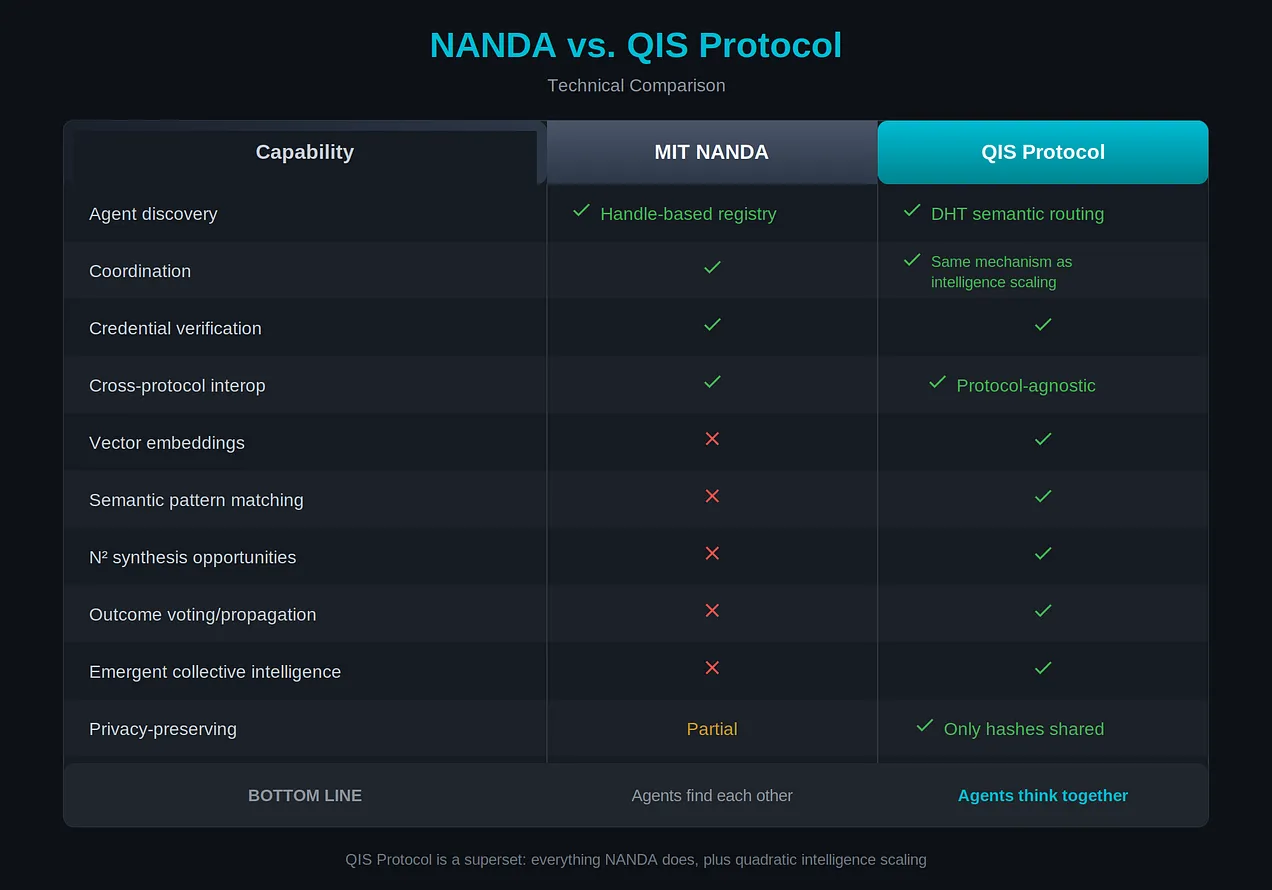
NANDA asks: "Where is the agent I'm looking for?"
QIS asks: "Where is the agent I'm looking for?" AND "Who has patterns like mine, and what happened to them?"
One is a subset. One is the full system.
The Timeline
MIT claims NANDA represents "10 years in development." That framing refers to Professor Raskar's broader research trajectory: AutoML in 2015, privacy-preserving machine learning in 2017, data markets in 2021. Valuable contributions. But the first NANDA paper hit arXiv on July 10, 2025.
My epiphany was June 16, 2025.
I started working on multi-agent architectures in April 2025 with Verve AI, a boardroom system where specialized agents collaborated on complex business tasks. I was already deep in agent coordination, vector databases, and distributed intelligence patterns.
Then my mother-in-law got diagnosed. I pivoted to Compass. And eight hours into that build, I saw the whole system: coordination AND quadratic scaling, unified in one architecture.
I'm not claiming MIT copied anything. We were working independently on related problems during the same period. What I am claiming is that I went deeper. I saw both layers. They published one.
What Rob van Kranenburg Saw
In September 2025, Rob van Kranenburg, founder of the IoT Council and an early advocate for autonomous vehicles and smart infrastructure, publicly validated QIS on Twitter. He called it "a perfect underlying system for when we have full coverage of self driving cars" and recognized it as a paradigm shift.
Rob has spent years advocating for networked intelligence infrastructure. When he saw QIS, he saw something worth endorsing publicly. That validation came from someone with a track record of recognizing transformative technology early.
The Invitation
I'm not here to diminish MIT's work. Building infrastructure for agent discovery is necessary. Someone needs to do it.
But I am here to stake a claim.
Quadratic intelligence scaling through distributed pattern synthesis is not in NANDA. It's not in any competing protocol. It's not in any academic paper I've found. To this day, no one else is working on this problem the way I've solved it. I've searched the literature extensively. The combination of DHT-based semantic routing, vector embedding synthesis, and N(N-1)/2 pattern scaling with logarithmic communication costs doesn't exist anywhere else. I saw it, I formalized it, I filed 39 provisional patents on it, and I've run over 100 simulations validating it.
The math is public. The protocol specification is on GitHub. The simulation results show R²=1.0 correlation for quadratic scaling. If I'm wrong, prove it. If I'm right, help me build it.
This isn't about credit. This is about deployment. The QIS Protocol could enable real-time treatment optimization across millions of cancer patients. It could detect sepsis 4-8 hours earlier than current methods. It could match rare disease patients with successful treatment patterns from the other side of the world.
Every month we delay is measured in preventable deaths.
MIT has 18 research institutions collaborating on NANDA. They have corporate partnerships with Cisco, Dell, TCS, AWS. They have summits and working groups and developer ecosystems.
I have a home office, 39 patents, and a mother-in-law fighting cancer.
The system demands credentials. The math doesn't care. Check the proof. Find errors or validate the rigor. That's all I'm asking. Check the Core Spec.
If you're an engineer, review the DHT routing claims. If you're a distributed systems expert, test the communication complexity bounds. If you're a healthcare researcher, look at the treatment optimization simulations.
And if you're at MIT working on NANDA, consider this: QIS could run on top of your coordination layer, or QIS could BE your coordination layer. Either way, the quadratic intelligence mechanism is what creates the value. That's not competition. That's an opportunity.
The question isn't whether agent networks will exist. They will. The question is whether those networks will just coordinate or actually think together for quadratic intelligence emergence.
I know which one saves more lives.
Contact
Timeline Reference
The patterns that will save lives tomorrow are scattered across devices today. I built the protocol that connects them. The math scales quadratically. The only thing that doesn't scale is time. Help me build it before it's too late for someone you love.
 Subscribe for New Articles